Your work already has real value. This guide is designed to help with carrying that story to the people who need to hear it — credibly, specifically, and honestly.
Africa has never been late to the values that define world-class tourism. Long before sustainable tourism became a global trend, many of its principles were already embedded across the continent and reflected in how visitors experienced Africa. Communicating Impact builds on this strong foundation that celebrates African innovation and community development, while helping tourism businesses measure and communicate impact in ways that are credible, measurable, and aligned with buyer expectations.
Despite being sustainability innovators for generations, African businesses face a structural disadvantage: the frameworks through which global buyers measure and validate sustainability were not designed with Africa in mind. Buyer demand for data is growing, and the cost of not meeting it is market access.
As a membership organisation at the heart of African tourism for over 30 years, ATTA® is uniquely positioned to support a new phase of sustainability maturity across its membership.
Communicating Impact exists to give African operators the practical capacity to translate what they have and what they have always done into a language buyers require, without diminishing the rich story in the process.
This guide is the product of a strategic collaboration with The Long Run, a specialist member-led organisation with 16 years of proven best practice, whose tools and frameworks help operators measure and communicate their impact. We are proud of this partnership. We hope this guide is a first step towards equipping ATTA® members with credible, actionable tools that are practical rather than burdensome; that help them measure what matters, communicate responsibly, and position African tourism as a global leader in holistic sustainability.
What the African tourism and hospitality industry lacks is not commitment to impact. It is the language to demonstrate it.
That is what we have repeatedly seen working with nature-based tourism businesses across Africa and beyond. The commitment runs deep. Operators are making decisions every day that put conservation first, that build genuine relationships with communities, that refuse shortcuts because they understand the true cost of taking them. The impact is real. What proves harder is translating that commitment into something tangible, something that travels up the supply chain, reaches the buyer, and lands with the guest; that is where the gap becomes quite acute.
This guide exists to close that gap.
At The Long Run, we have always started from impact rather than efficiency. Not ‘do you have the right policies in place?’, but rather: ‘what is the change you are aspiring to, and how does your work contribute to it?’ The 4C Framework, running throughout this guide, reflects that thinking. Conservation, Community, Culture, and Commerce are not four separate boxes to tick. They are four interconnected pillars of a business that understands its role in the broader system it operates within. When all four are working together, the impact story is already there. The job at hand is to share that impact credibly and in a way that resonates through the value chain.
We are proud to bring that framework to a wider audience through this partnership with ATTA, and glad to share what sixteen years of working alongside some of the most committed operators in the world has taught us: that doing good is not enough. The work needs to be visible, specific, and honest. That is what this guide will help you do, and as The Long Run, we are here to support you on that journey.
The four pillars running through this guide, Conservation, Community, Culture, and Commerce, form The Long Run’s 4C Framework. Developed over sixteen years of working with nature-based tourism businesses across Africa and beyond, the 4Cs provide a holistic lens for understanding and communicating impact. They underpin The Long Run’s Global Ecosphere Retreats® (GER) standard and are used by member businesses worldwide to plan, measure, report and enhance their sustainability practice.
This guide is built around the 4Cs because they reflect how the most impactful tourism businesses in Africa think about their work: not as separate concerns, but as four interconnected areas that lead to a far stronger practice of sustainable and regenerative operations over the long term. Learn more at thelongrun.org.
Think about the last time you talked about your impact. Maybe it was in a meeting with a buyer, a caption you wrote for a community project, or a paragraph on your website you updated six months ago. You said something true. But did it land? Or did it vanish into the noise of an industry where everyone seems committed to conservation, proud to support local communities, and dedicated to responsible travel?
That gap, between knowing your work has real value and not being sure your story is carrying that weight, is what this guide is designed to bridge.
What you will find here are practical tools for examining what you are already doing, finding the story inside it, and sharing it with the people who need to hear it.
One thing to state before we begin: the conservation models, community partnerships, and cultural stewardship practices being developed across Africa are among the most instructive in the world. This guide exists to help you communicate that, on your terms, in your voice, with the specificity it deserves.
And while this guide focuses on communication, it is underpinned by a simple fact: sustainability that exists only in your marketing materials is not sustainability. The businesses that communicate impact most convincingly are the ones where it shows up in procurement decisions, in how they hire, in what they refuse to do, and in how they think about financial resilience. Communication that is not rooted in practice will not hold.
“When I’m trying to understand whether a property’s impact is real, I look for specificity over generalisations. It’s not enough to say ‘we support local communities.’ The most meaningful metrics often emerge from conversations with the people who actually work in camp — like a head of housekeeping who has been with the same company for 12 years, telling you that her daughter has just qualified as a field guide. Vague virtue is invisible to readers. Personal stories resonate. If properties want their impact to land, they need to resist the urge to summarise and find the granular detail that makes the whole thing undeniable.”Jane BroughtonTravel Writer, Content Strategist & Storyteller
| Section | What it covers |
|---|---|
| 01 Know Your Why | Getting clear on the values and mission at the root of your business |
| 02 Know Your Impact | Taking stock of what you are already doing across the 4Cs |
| 03 Regulation, Evidence & Accountability | Understanding the regulatory landscape and what it means for your claims |
| 04 Know Your Audience | Reaching trade partners, guests, and media with the right message |
| 05 Stay Credible | Navigating the greenwashing line with confidence, not caution |
| 06 Build the Habit | Making impact communication a consistent part of how you work |
| 07 In Practice | Real operators, real stories, real lessons from across the continent |
| A Appendix — Tools | A basic data collection framework |
You can read it straight through or go directly to the section that is most pressing right now. Each section ends with a Quick Action.
| Tool | Section |
|---|---|
| The 4C taking-stock questions (Conservation, Community, Culture, Commerce) | 02 — Know Your Impact |
| The three questions: who specifically, what specifically, how do you know | 02 — Know Your Impact |
| The four buyer questions: people, place, practice, proof | 04 — Know Your Audience |
| The three-question credibility test | 05 — Stay Credible |
| The notice — record — share practice framework | 06 — Build the Habit |
You cannot tell your impact story well until your why is clear. Not as a line on a website, but as something your whole team understands and believes. When the why is genuinely embedded, impact communication stops being an effort. The story is already happening. You are just finding the words for it.
Most businesses that struggle to communicate their impact are not struggling because they lack stories or evidence. The problem is usually that the values driving the business have never been fully said out loud, or that what was once clear has become so familiar it’s become invisible.
This section helps you bring that back into focus: the mission and values that should run through everything you communicate, from a trade pitch to a guide briefing to an Instagram caption.
The phrase ‘sustainable travel’ gets used so often that it has lost its meaning. You may also hear or read the terms ‘regenerative travel’ or ‘responsible tourism’ now used interchangeably with sustainable travel. It is worth deciding consciously which language reflects how your business works, rather than reaching for the nearest available buzzword and becoming indistinguishable.
Your mission is not a sustainability statement. It is the reason your business exists. When your conservation work, community relationships, and cultural commitments flow from a clearly articulated mission, they feel coherent. This builds trust.
The businesses that communicate their impact most naturally are usually the ones that can answer three questions without hesitating:
If different people in your business give different answers, this is the right moment to work on it.
Think about what motivates your team. If you asked each of them why they work here, what would they say? If they struggle to answer, or simply say ‘because it pays well’, that is useful information: it tells you the why has not yet made it far enough into the organisation to anchor how you talk about yourselves to the outside world. That is not a failure; it is simply where the work begins. But if the answer involves a place, a community, a way of doing things that matters to them personally, that is the story.
Often the why is already there, lived out in daily decisions, long before anyone has written it down.
Write one sentence that captures why your business exists, without using the words sustainable, responsible, eco, or committed. If you cannot get there without those words, keep going and dig deeper; the struggle is part of the work. Extend this by putting this same task to your extended team or a mixed selection of colleagues in the organisation and gather a sample of answers.
Businesses that can tell a specific impact story to their clients have a more persuasive product to sell. Clients who book because of real, evidenced claims arrive with more accurate expectations, have better experiences, and are more likely to return and recommend. The commercial case for impact communication is not abstract: it shows up in repeat bookings, in referrals, and in the quality of enquiries coming through the door.
Here is something most operators discover when they sit down to do this: they are doing far more than they thought. The supplier you have been buying from for seven years because she grows the best tomatoes and you like supporting the village. The guide who knows the name of every family that has ever lived in this valley and shares that knowledge with guests in a way no script could capture. The decision you made three years ago not to take on a particular partnership because of what it would have done to the wetland.
None of that appears in a standard reporting template. All of it is your story.
Before you can communicate your impact, you need to know what you are working with. That means taking honest stock, not to build a report, but to find the raw material for a story.
The Long Run’s 4C Framework organises impact across four interconnected pillars. Looking honestly at your work across all four before asking whether you can prove any of it is the most useful place to begin. The connections between the pillars matter as much as the pillars themselves.
For accommodation providers, much of this impact is direct, shaped by what happens on your own land and in your own operation. For DMCs, tour operators and other travel businesses, it works differently but matters just as much: your impact comes through influence and design, where you send clients, who you choose as suppliers, and how you build an itinerary. Both forms of impact count equally. As you work through the questions, read them through whichever lens fits your business.
What are you doing to protect and support the natural environment your business depends on, directly and through the choices you make for others?
Who benefits from this business being here, beyond your guests and your bottom line, and how far does that reach across everyone you touch?
Is the living culture of the destination genuinely present in what you offer guests, and is it led by the people whose culture it is?
Is your business financially strong enough to sustain all of the above over the long term? Commerce is the engine that makes the other three possible.
The 4C Framework is The Long Run’s own methodology, used across our global membership to measure and communicate holistic impact. To explore the framework further and learn about The Long Run’s work with accommodation providers and travel businesses, visit thelongrun.org.
Your most powerful impact stories are probably not the ones you lead with. They are the ones so deeply embedded in how you operate that you have stopped thinking of them as stories at all: the practices new staff absorb without anyone calling them “policy”, the decisions that happen automatically because they reflect who you are.
Ask yourself: what do we do here that would genuinely surprise an outsider? Those are usually the places where your values are most visible and most credible.
Write down three things your business does that would genuinely surprise an outsider. Not what is in your brochure — what is simply how you operate. That list is your starting inventory.
You have taken stock of your impact, and you are ready to get into the storytelling. At this point it is prudent to pause and discuss the big legislative elephant in the room – regulation.
For as long as this industry has talked about sustainability, the rules around what you could say were largely unwritten. Vague language was everywhere. Generic claims went unchallenged. That is changing — significantly, and soon.
On 27 September 2026, the European Union’s Directive on Empowering Consumers for the Green Transition (Directive EU 2024/825, known as EmpCo) comes into force. From that date, environmental claims made to European consumers must be specific, substantiated, and verifiable. The scope is deliberately broad: if European consumers are seeing your sustainability claims, directly or through a trade partner, you are in scope whether you are a lodge in Botswana with German guests or a tour operator in Nairobi listed on a Dutch booking platform.
The penalties are serious: fines of at least 4% of annual turnover in the relevant country, confiscation of revenues from non-compliant claims, exclusion from public procurement, and mandatory corrective advertising at the company’s expense.
For African operators, the practical consequence is simple: the trade partners who sell your product to European travellers are now legally responsible for the sustainability claims they make. They will ask their suppliers to substantiate those claims, or they will find suppliers who can.
“An operator who can hand a buyer a specific, evidenced impact summary is not just easier to sell, but significantly lower risk under the new legal environment.”Jarrod KyteSteppes Travel
The operators best positioned under the new rules are not necessarily those with the most sophisticated sustainability programmes; they are the ones who can document and communicate what they are already doing, specifically and honestly. The habits this guide asks you to build, specific claims, evidenced outcomes, honest acknowledgement of what you are still working on, are exactly the habits that make a business compliant. Doing this well is no longer just good communication. It is a legal baseline.
With September 2026 approaching, there is still time to scan your current sustainability language against the new requirements. Start with your website and brochureware.
Sources: European Commission, Directive (EU) 2024/825; EarthCheck, ‘The EU just changed the rules on tourism marketing’, June 2026. This section is for guidance only and does not constitute legal advice.
The regulation chapter told you what you cannot say without evidence. Now, what evidence looks like and what you need to start?
There is a common assumption that proper impact measurement requires a dedicated sustainability manager, a reporting platform, or a full audit cycle. For most African tourism businesses, those things are not realistic at the start. What is realistic is a minimum viable dataset: a defined set of data points, collected consistently year on year, that gives you the foundation to make credible claims, satisfy trade-partner due diligence, and meet regulatory scrutiny when the time comes.
The difference between a claim you can substantiate and one you cannot is often not a question of what you are doing, it is a question of whether you wrote it down. An operator who has employed 80% local staff for ten years but never recorded the number is in a weaker position than one who started last year and tracked it from the beginning.
Trade partners building itineraries for European clients are increasingly required to document their supply chain’s sustainability credentials. Without them, you are asking a buyer to take your word for it, and increasingly, they cannot afford to.
What does that defined set of data points look like in practice? That is work The Long Run does with its members every day. For this guide we have developed a baseline measurement framework aligned with GRI, GSTC, Travalyst, and the WTTC Hotel Sustainability Basics, calibrated to what is achievable for operations without dedicated reporting infrastructure. If you are ready to put structured measurement in place but do not know where to start, the tool in the appendix is a great place to begin.
The framework we’ve developed for this guide aligns with several global standards and reflects best practices in data collection. Most of the data you will already have, while some you will need to start collecting. None requires specialist infrastructure to track.
Having the data is not the same as having the story. The data is the foundation. The story is what happens when you ask one question of it: what does this number mean for the people involved in it?
That question is the translation step. To find the insight in any data point, ask: if I showed this number to the person most connected to what it represents, what would it mean to them? Their answer is your insight.
Here is what that translation looks like in practice. The left column is where most operators start. The right column is where this guide is asking you to get to.
The most reliable way to close the gap between evidence and story is to move the camera from the programme to the person. A programme is abstract. A person is specific. And specificity, a name, a place, a detail particular to this business and nowhere else, is what makes a story worth trusting.
For each of the 4Cs where your business is creating real impact, ask: is there one person, a guide, a waiter, a community partner, a supplier, whose relationship with this business is the most honest expression of that work? That person is the anchor. The data and outcomes make the anchor credible.
“Hotels and lodges, in my experience, often achieve genuinely impactful sustainability work on the ground, but fall short in translating that into compelling communication. The gap is not a lack of effort: it is a lack of structured storytelling. When operators learn to frame their work through clear, specific narratives, the response from media, buyers, and guests changes immediately.”Claire RoadleyFounder, Umlingo Travel PR
The same story does not work the same way for everyone. What lands with a trade buyer in a pre-trip briefing document will not land with a guest on their second evening around the fire. And neither of those will work as a media pitch. Knowing your audience is not just knowing who they are. It is knowing what they need from your story, in what form, at what moment.
In most African tourism businesses, the impact story lives at the property: the lodge, the conservancy, or town, this is where the conservation work happens, where community relationships are built, where the cultural knowledge resides. It is also, too often, where the story stops.
By the time a guest books a trip, they have usually passed through two or three intermediaries. Whether your story arrives with them intact or dissolves somewhere along the way into generic sustainability language, depends almost entirely on whether you have made it easy to carry.
Trade partners are not buying your sustainability story; they are buying confidence. Confidence that they can describe your property accurately, stand behind what they say if pressed, and book you without creating problems to manage later. They need something they can repeat in two or three sentences without having to simplify it, something they can verify, and something that connects directly to the experience they are selling, not a sustainability appendix, but the reason this place is worth visiting.
These four questions map directly to The Long Run’s 4C Framework. If you have worked through Section 02, you already have the material to answer them.
Liesel van Zyl of Go2Africa works with around 1,400 suppliers. Her observation is pointed: operators who have invested in certification, even early-stage certification, are significantly easier to sell. Not because buyers require a badge, but because the process of getting certified forces operators to document and articulate what they are already doing. The story becomes portable.
Richard Walton is direct about what agents actually need from you: ‘Tell them about the child whose school was built through lodge revenues, the ranger who was trained from the community, the species that came back. Give them something they can repeat in a conversation, not a PDF they’ll forget.’
Wetu’s analysis of agent behaviour reveals something straightforward and important: the properties that get selected most often are not always the most famous or the closest to the game reserve. They are the ones whose supplier profile gives the agent the most to work with. Taking it a step further Wetu now offers a dedicated Sustainability Profile feature, allowing suppliers to document and share their practice directly within their agent-facing profiles. Read more here.
Most travellers do not book a trip because of a property’s sustainability credentials. Research consistently shows that value, experience quality, and destination appeal come first. The word ‘sustainability’ can actually create distance rather than desire: it can sound like a constraint, a lecture, or something the traveller is expected to feel guilty about.
“The minute you say the word sustainability, people shut up. Agents just kind of shut down. But if I tell them an inspiring story about a kid from the community who made it to the Olympic trials, suddenly you hear: oh, that’s incredible.”Ruth CrichtonSouthern Africa Hub Manager, The Long Run
Impact does not replace the experience. It deepens it. The most powerful impact communication you will ever do happens not in a brochure or a trade pitch, but in the experience itself. In-destination storytelling is about building experiences in which the impact is visible and real, where the people, the place, and the practice do the communicating. Your job is to create the conditions for that: to invest in the guides, community liaisons, and cultural interpreters who carry the story, and to give them the space to share it in their own voice. The guest does not need to know they are receiving an impact communication. They just need to feel that this place is real, and that it matters.
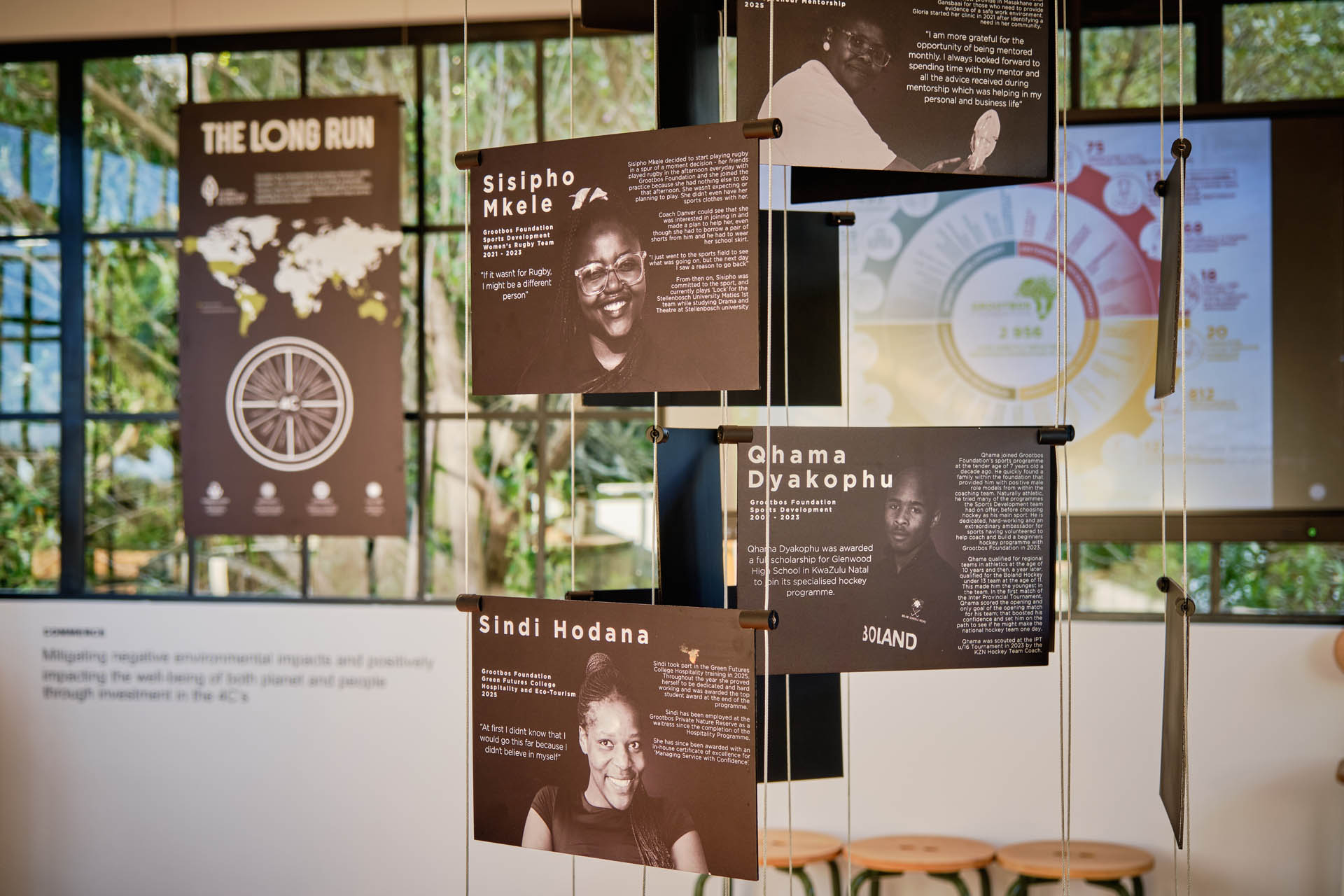
Grootbos Private Nature Reserve in South Africa does this deliberately: every guest begins their stay with an introduction to the 4Cs in practice at the Glass House, helping them understand the property’s purpose before their first activity. By the time they are in the landscape, they are already part of the story.
“How do we know whether a hotel is genuinely doing good? For me it usually comes down to a simple equation: is a place creating more positive impact for nature than negative? Is the sum of its footprint — its build, its supply chain — outweighed by what it gives back: the habitat it protects, the species it counts, the communities where money is left with so they can look after their land?”Juliet KinsmanSustainability Expert and Solutions-led Storyteller, Journalist and Broadcaster
A journalist is not looking for a sustainability project. They are looking for a story their readers will care about, that their editor will commission, and that they can stand behind when it is published. The story itself is usually about a person, a decision, a consequence, or a surprise.
Many operators pitch their impact practice as the story. What they should be pitching is the human story their impact practice has made possible. ‘We have an award-winning conservation programme’ is not a story. ‘The man who has counted every elephant in this ecosystem for eighteen years, and what he saw change’ is a story.
The detail that seems too local is often the detail that makes the story worth telling. Find the one sentence, the one image, the one fact that opens the door to everything else — and lead with that.
Write a two-sentence description of your most distinctive impact — specific enough that a trade partner could repeat it to a client today, without needing to simplify it. If two sentences is not enough, the story needs more work before it needs more channels.
Most operators who worry about greenwashing are not greenwashers. They are people who care too much about their work to be comfortable exaggerating it. That is the right instinct.
But taken too far, it becomes a different problem. Staying silent about real, meaningful work because you are afraid of saying the wrong thing, what the industry calls greenhushing, is just as damaging. It leaves genuine stories untold and cedes the conversation to people who are far less careful than you.
The context matters. The World Economic Forum’s 2025 Global Risks Report ranked misinformation and disinformation as the number-one short-term global risk — ahead of climate change, inequality, and armed conflict. In that environment, bold sustainability claims without substance will backfire faster than ever. But the flip side is powerful: authentic, evidenced impact builds trust faster than any promotion.
Greenwashing means creating a misleading impression of your environmental or social impact through overclaiming, vague language, selective emphasis, or presenting ambitions as if they were already achieved. In tourism it is usually not deliberate. It is a habit, and like most habits, it is easier to break once you can see it clearly.
Greenhushing is the mirror failure: saying less than you should, leaving real work unacknowledged, and quietly removing yourself from a conversation your industry badly needs you in.
These patterns are not exclusive to bad actors. They show up in the communications of businesses doing genuinely good work. Naming them is not an accusation; it is a starting point.
If you saw yourself in any of those: good. That awareness is the beginning of replacing them with something more honest and, in practice, more persuasive.
Before you use any impact claim, in a trade pitch, a client itinerary, on your website, in a social post, run it through three questions. If the answers are all yes, communicate with confidence. If any one gives you pause, that is where to do more work before you publish.
| Question | What you are actually testing |
|---|---|
| Is this specific? | Does it name something particular, a place, a person, a practice, a number, or describe a general direction? Specifics can be verified. Generalities cannot. |
| Can I evidence it? | Not necessarily in a published report. But in something: a figure, a named partner, a practice you could describe in enough detail that someone else could check it. |
| Does the overall impression match the overall reality? | Individual claims can be accurate while the picture they create together misleads. Ask honestly: would a well-informed, sceptical reader feel you had represented your work fairly? |
Take your current sales-deck page or most recent brochure. For every claim, ask the three questions — specific, evidenced, accurate overall impression. Mark anything that does not pass all three.
Come back to where we started. You told your impact story. You said something true. And you were not sure it landed. The work in the sections you have just read gives you something different to work with now: a clear why, an honest picture of what you do across the 4Cs, tools for reaching the audiences who matter, and a way to stay on the right side of credibility. The last piece is making this consistent, so it happens as an integrated part of how you run the practice.
The businesses that communicate their impact well are not the ones with the biggest teams or the largest communications budgets. They are the ones who have built a habit: a small, steady practice of noticing, recording, and sharing that runs in the background of everything else they do.
| Step | What it looks like in practice |
|---|---|
| 01 Notice | Someone on your team, it does not need to be the same person every time, stays alert to impact moments as they happen. A guest conversation that opened something up. A supplier relationship that has grown into something meaningful. A conservation observation worth documenting. The moments are there. The practice is deciding to catch them. |
| 02 Record | A shared folder, a note in a group chat, a page in a notebook, wherever impact moments get captured as they happen, without being polished first. A date, a name, a description. That is your raw material. |
| 03 Share | A regular moment, quarterly, before a trade show, at the start of a new season, to look at what you have captured and decide what is worth developing. One story, told specifically and placed in the right channel, will do more work than a year of generic sustainability posts. |
Set up a monthly story-sharing day with your team and champions from other departments, to start collecting and inspiring the practice of internal storytelling.
What impact communication looks like when it is working.
Principles only get you so far. The case studies that follow show what the ideas in this guide look like when they are being lived by real businesses, in real African operating contexts. They are not polished success stories: each one contains a moment of genuine difficulty: a decision that cost something, a gap that had to be owned, a point where the right path was harder than the easy one.
That is what makes them instructive. Read them for what is specific, not for what is inspiring.
Borana Conservancy, Kenya — © James Lewin · Singita — Kruger National Park, South Africa — © Ross Couper
A founding member of The Long Run and a certified Global Ecosphere Retreat®. Over two decades, Segera has transformed 50,000 acres of degraded cattle ranch on Kenya’s Laikipia plateau into a thriving wildlife sanctuary.
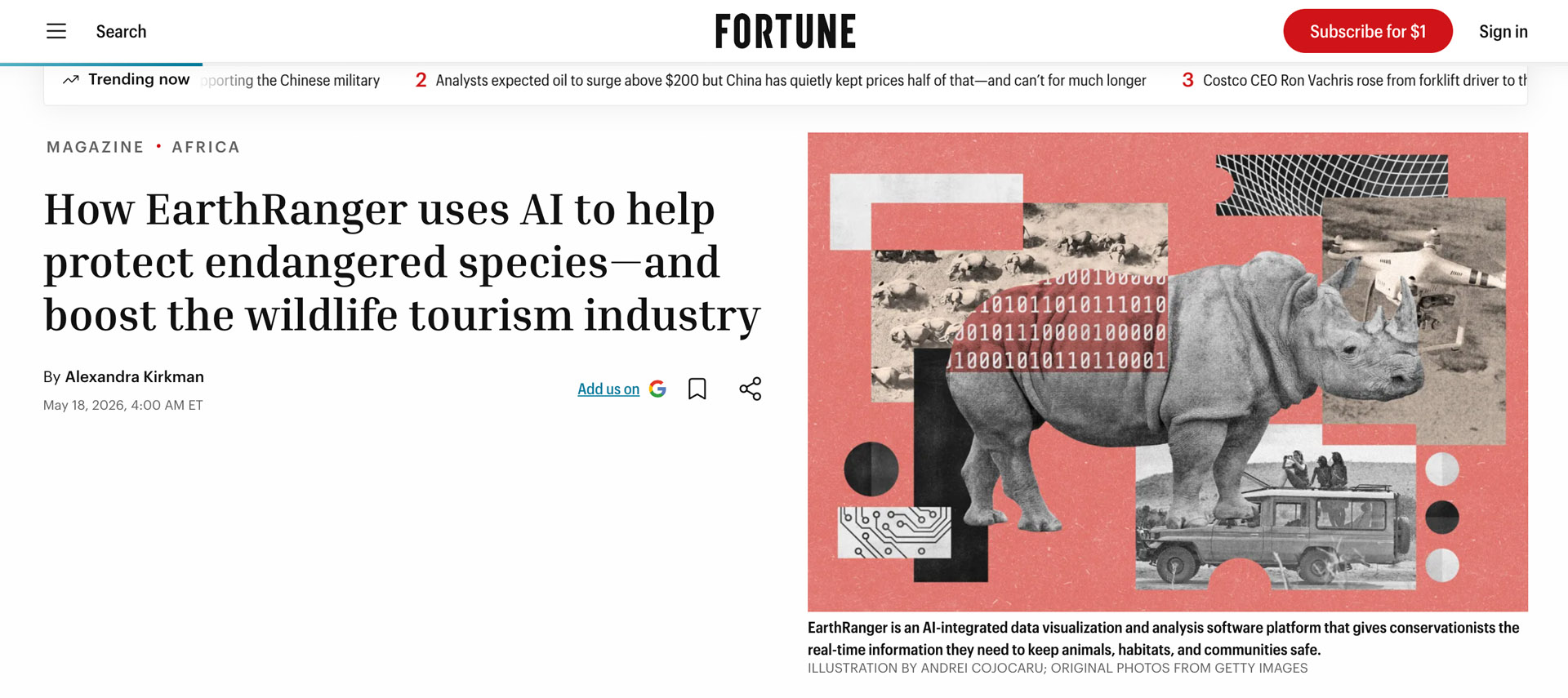
While most people churn out AI posts shrouded in fear and hysteria, Segera told the story of how they are using AI to reduce the cost of conservation. The team was clever to publish a piece of hope and goodwill at a time when AI is so often associated with threat. The full story ended up in Fortune magazine, earning plenty of positive press and eyeballs. Read the piece in Fortune.
The lesson: take a mainstream conversation and turn it on its head. It pays to look at things differently.
Kwandwe has reclaimed 30,000 hectares of farmland in the Eastern Cape, South Africa, for wildlife conservation, reintroducing endangered black rhino and returning cheetah to the Great Fish River Valley for the first time since 1888.
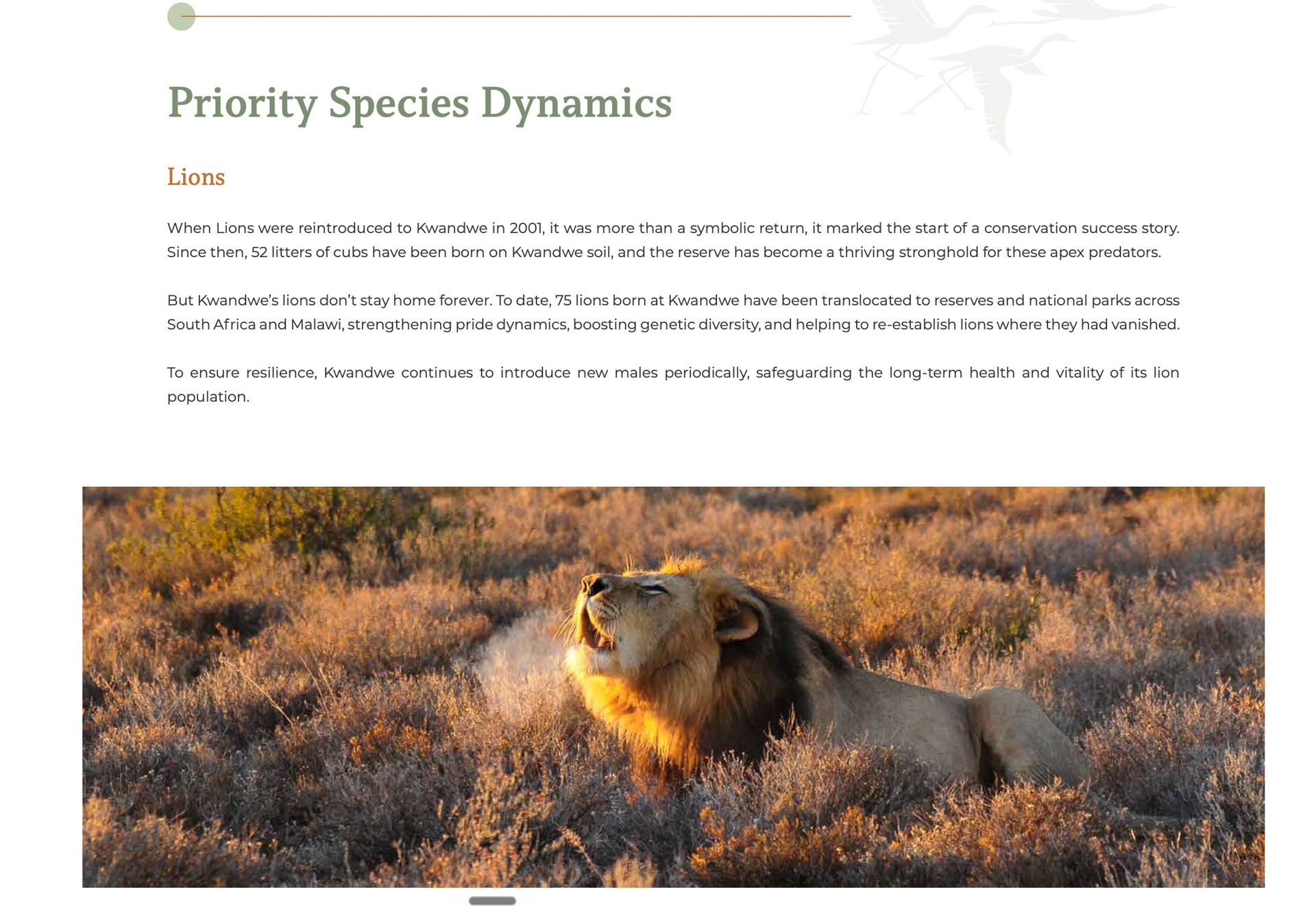
One of Kwandwe’s top-performing Instagram videos is about two lions being relocated to Nambiti Private Game Reserve. It’s a simple reel made up of photo and video content shot from a phone (no massive marketing budgets). But it resonates because the moment is real and rare, the kind of behind-the-scenes footage guests almost never get to see.
The lesson: being there matters more than production value. If you are present for the moments that matter, a phone is enough.
Singita’s Lebombo and Sweni lodges sit in South Africa’s Kruger National Park, where the Singita Lowveld Trust, their non-profit partner in the Greater Kruger region, drives conservation and community work towards Singita’s 100-year purpose.
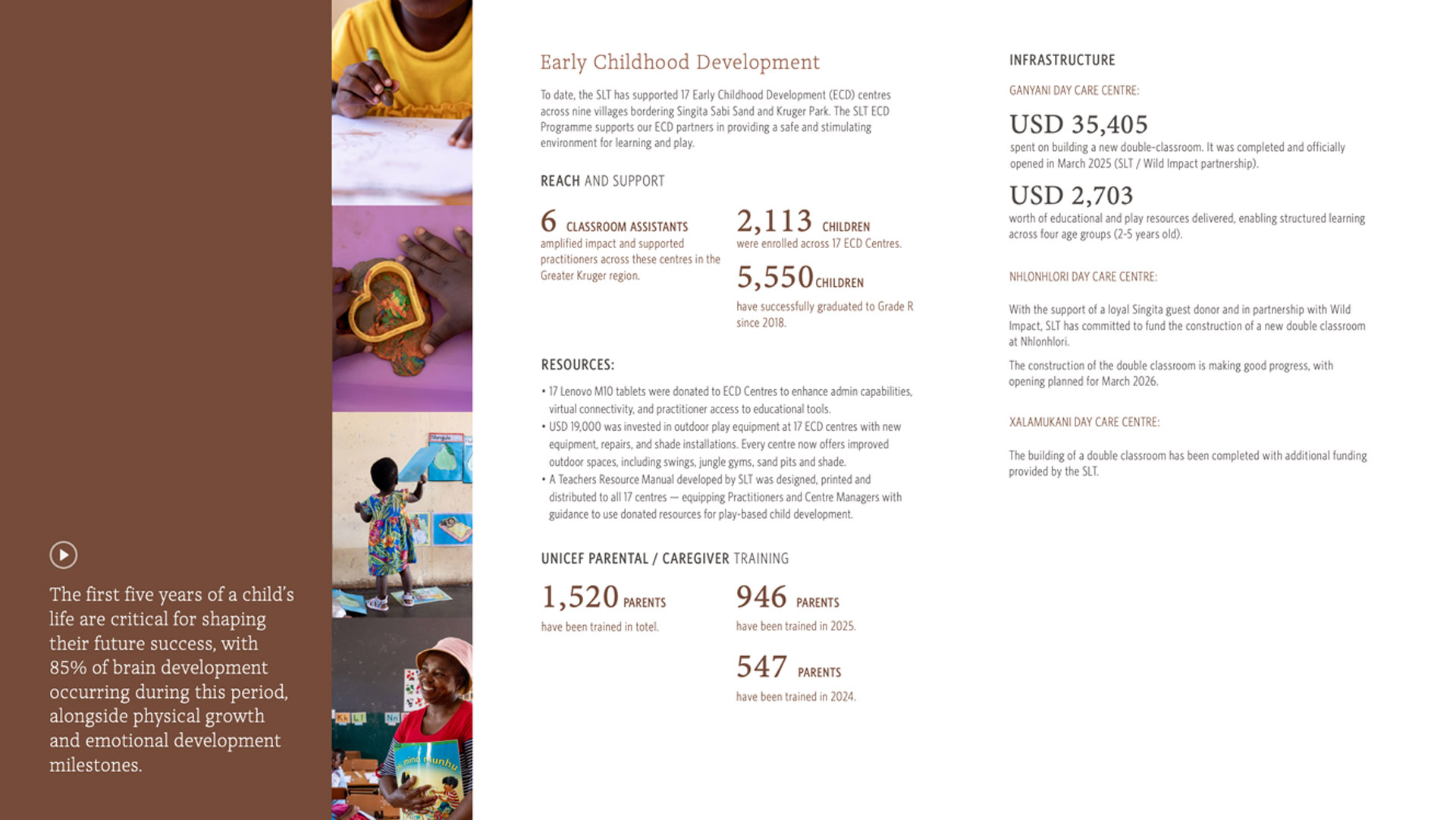
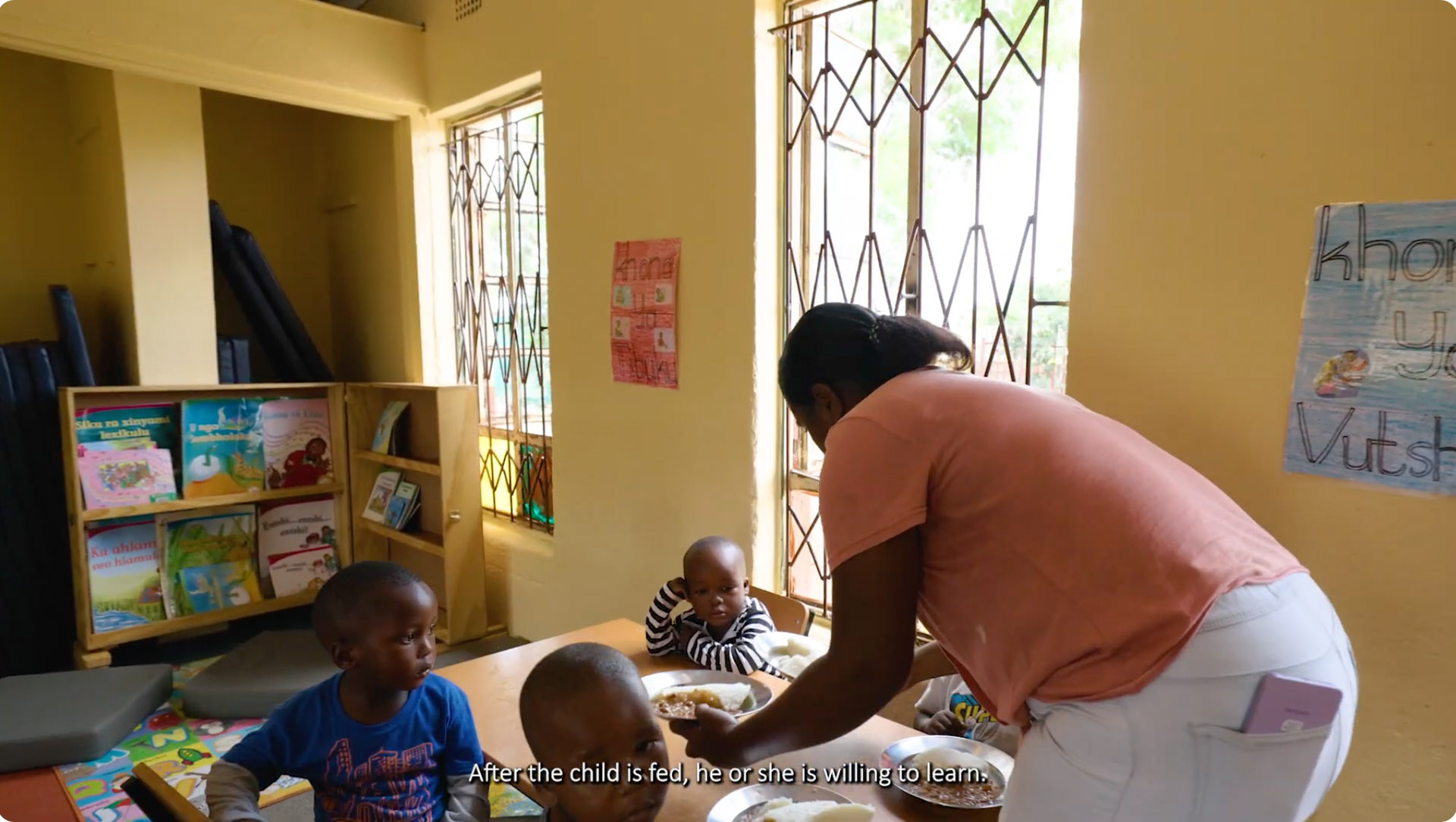
With so much content fighting for attention, we have to whittle stories down to what makes people feel something, then back the story up with numbers. Singita does this expertly on just one page with their Lowveld Trust Impact Dashboards. They open with a short YouTube video that has you smiling, with a few tears welling up, in the first 40 seconds. The narrator’s passion carries the story, and you start to care about what the numbers mean. Singita does not give a school ‘resources’ (a stodgy word that means nothing); it gives a child blocks to play with. In a safe school environment with enough food, that child can play freely, use their imagination, and may just become a builder one day. What Singita has actually done is give 2,113 children bordering their Singita Sabi Sand and Kruger properties a chance at a better life.
The lesson: lead with feeling, and let the numbers prove it.
A family-run, eight-room lodge on the banks of the Mara River in Kenya’s Maasai Mara, whose founders established the 6,000-acre community-based Enonkishu Conservancy.
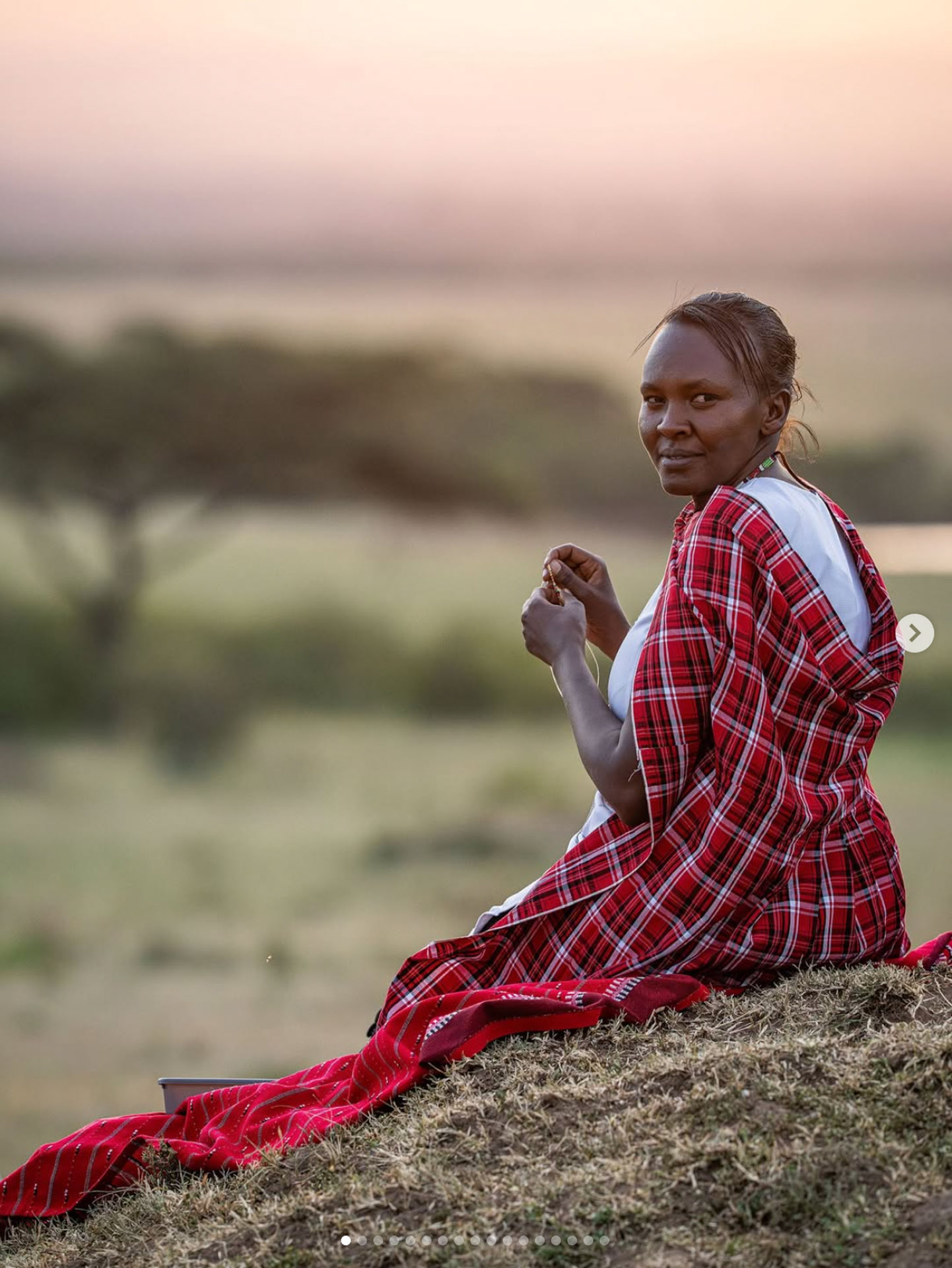
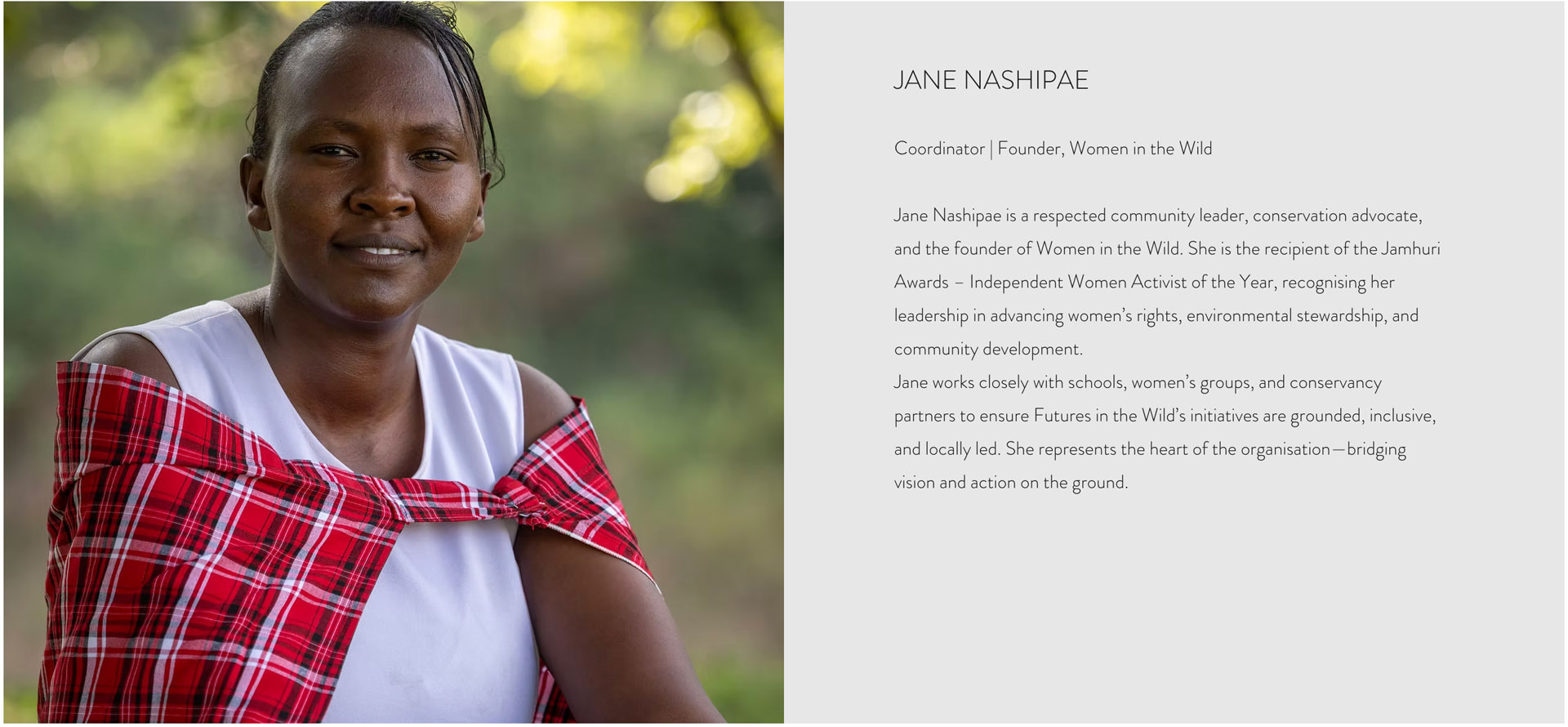
The team see themselves as custodians of a small part of the wider Maasai community, with a responsibility to use their business to give back to those who cared for this place long before they arrived. Local leader Jane Nashipae has become an award-winning activist, and House in the Wild weaves her voice seamlessly into their own — across their website, their Instagram, and their press. But it does not only live online: after Jane tells the story of her Trees in the Wild nursery project, guests are invited to plant a tree with her. They leave as stewards rather than consumers, and they carry the story far and wide long after their trip has ended. The project has been so successful that government officials now ask for Jane’s help to meet Kenya’s target of planting 15 billion trees by 2032. As she told House & Garden UK, with a giggle: “We’ve had a 90 per cent success rate. They should have listened to us first.”
The lesson: give a community leader’s voice the same platform you would give a founder. Jane is not a beneficiary in this story — she is one of its leaders, and the storytelling treats her that way.
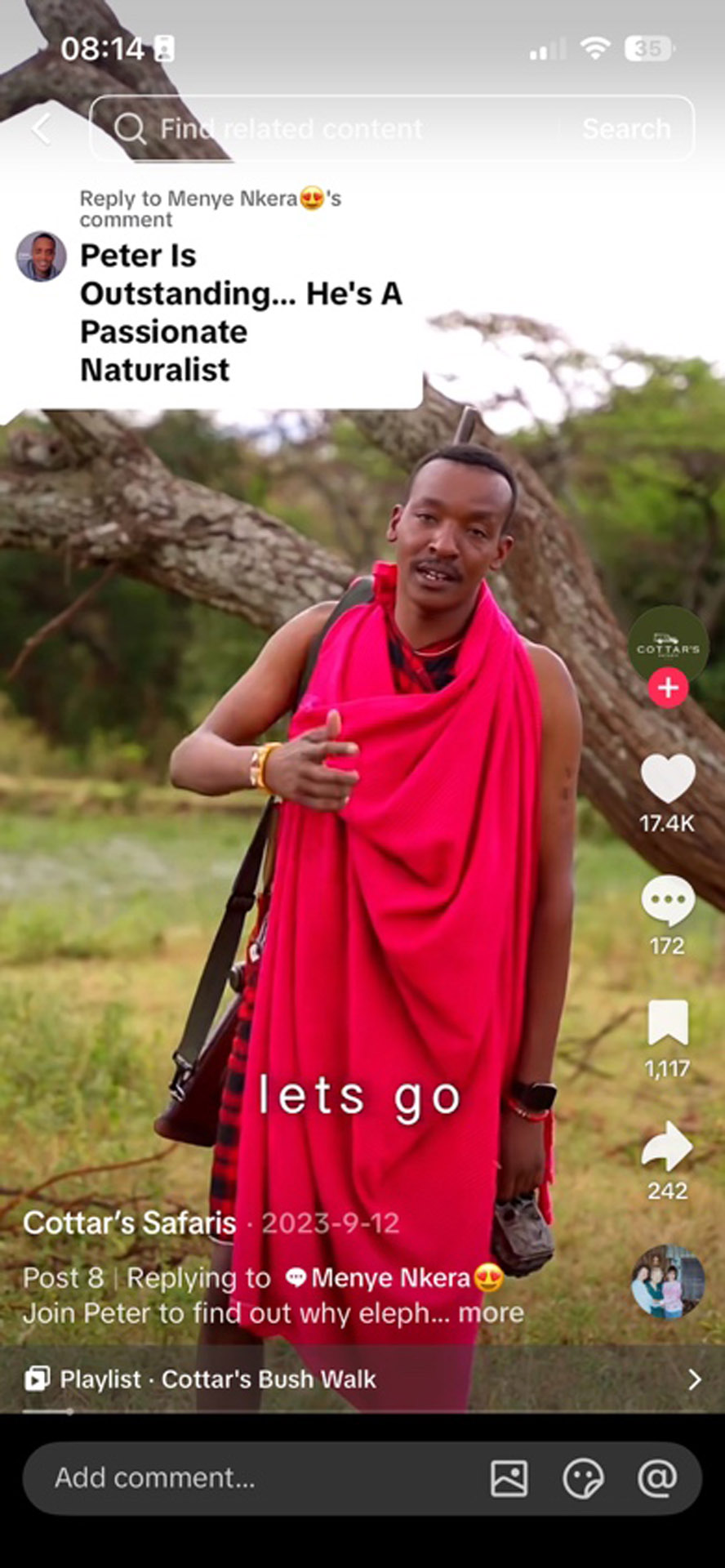
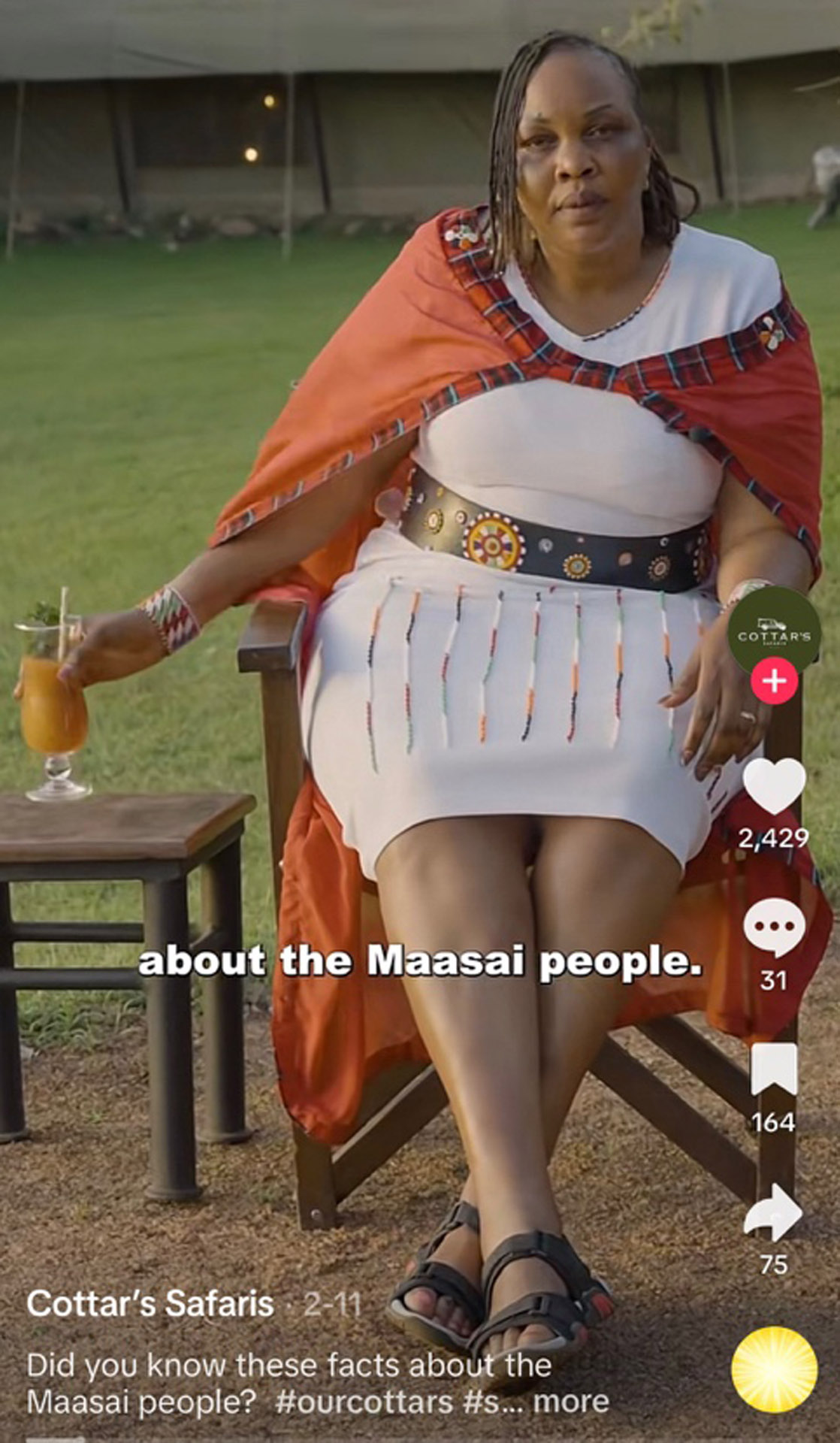
In the safari business since 1919, Cottar’s sits on a conservancy in Kenya’s Maasai Mara owned by a 7,300-strong community of Maasai landowners and was the first property in the world to earn Global Ecosphere Retreat® certification.
Cottar’s have racked up millions of fans on TikTok by getting the local Maasai community behind the camera. The intent is to make sure Maasai team members have the strongest voice in how their heritage is represented and shared (rather than a top-down approach). The secret to their viral success is that they do not take themselves too seriously; the quirks and humour of each character are what make the storytelling magnetic.
The lesson: impact storytelling is allowed to be funny. In a sector that takes itself very seriously, a sense of humour travels far.
A lodge in northern Kenya’s Westgate Community Conservancy, home to over 600 Samburu families, where guest fees fund conservation and community development. Sasaab is a certified Global Ecosphere Retreat®.
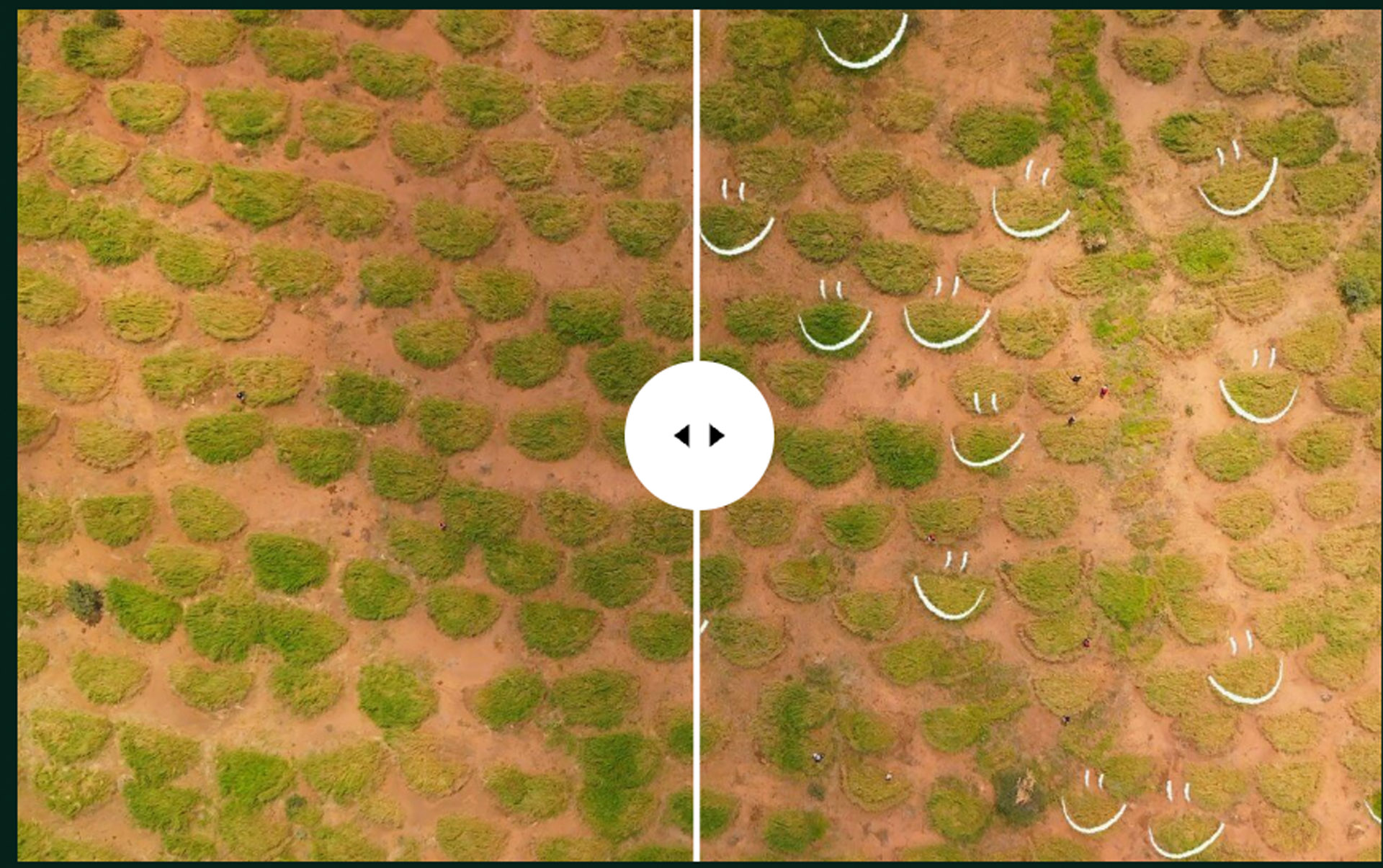
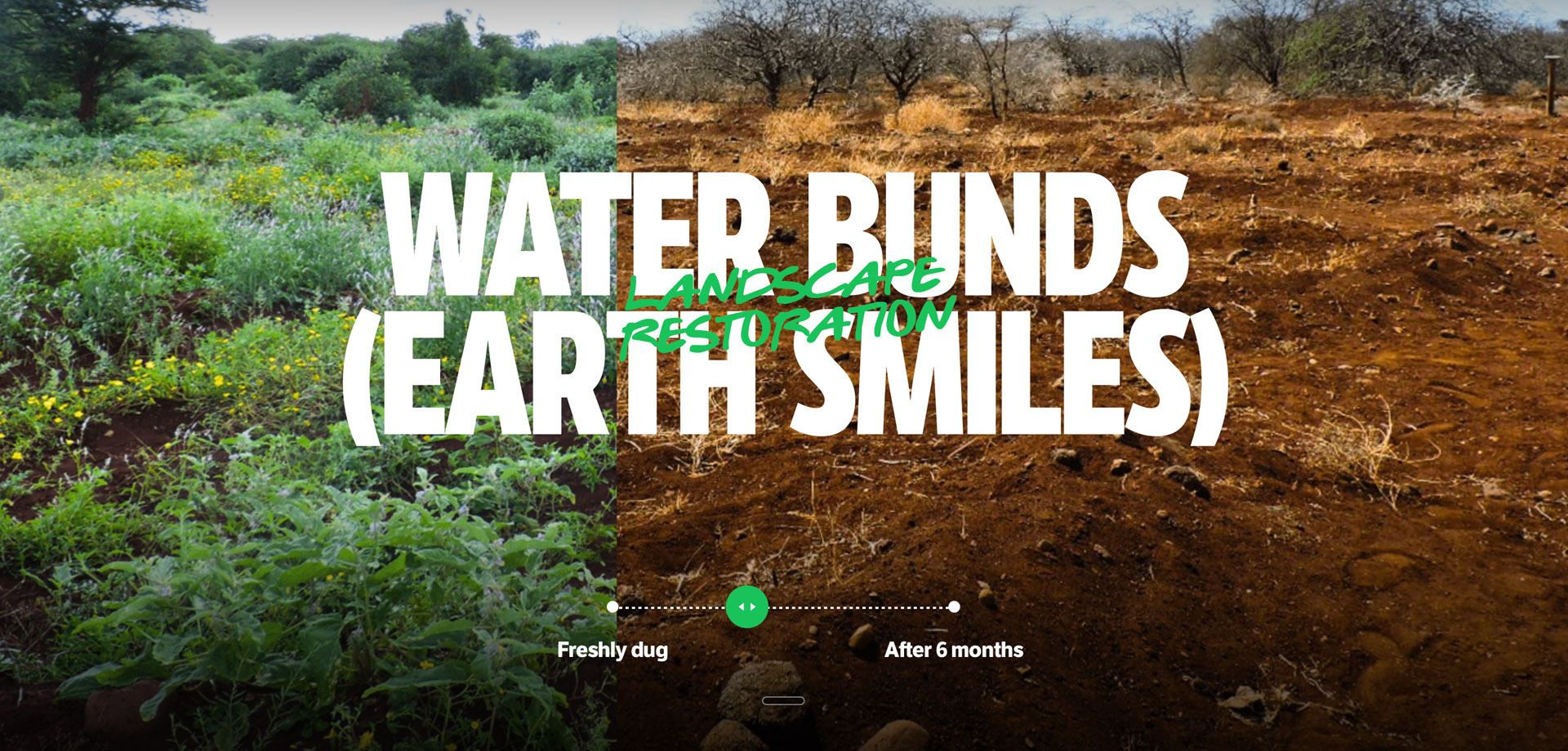
In Samburu, semi-circular pits dug into degraded land capture rainwater that would otherwise wash away. That is the technical version. The version that travelled is the one in the name: the pits are shaped like half-moons, so the project calls them Earth Smiles. Spearheaded by Justdiggit, with Sasaab’s Footprint Trust donating grass seeds and joining the digging, the project has grown from 1,000 bunds in 2022 to 90,000 bunds today. The digging events unite partners and the Samburu community, and the women who dug now run grass-seed banks that earn income for their families. The proof is told in the simplest format there is: a photo of bare earth, and a photo of the same spot six months later, green.
The lesson: the simplest devices work hardest. If people can visualise it, they are far more likely to buy into it.
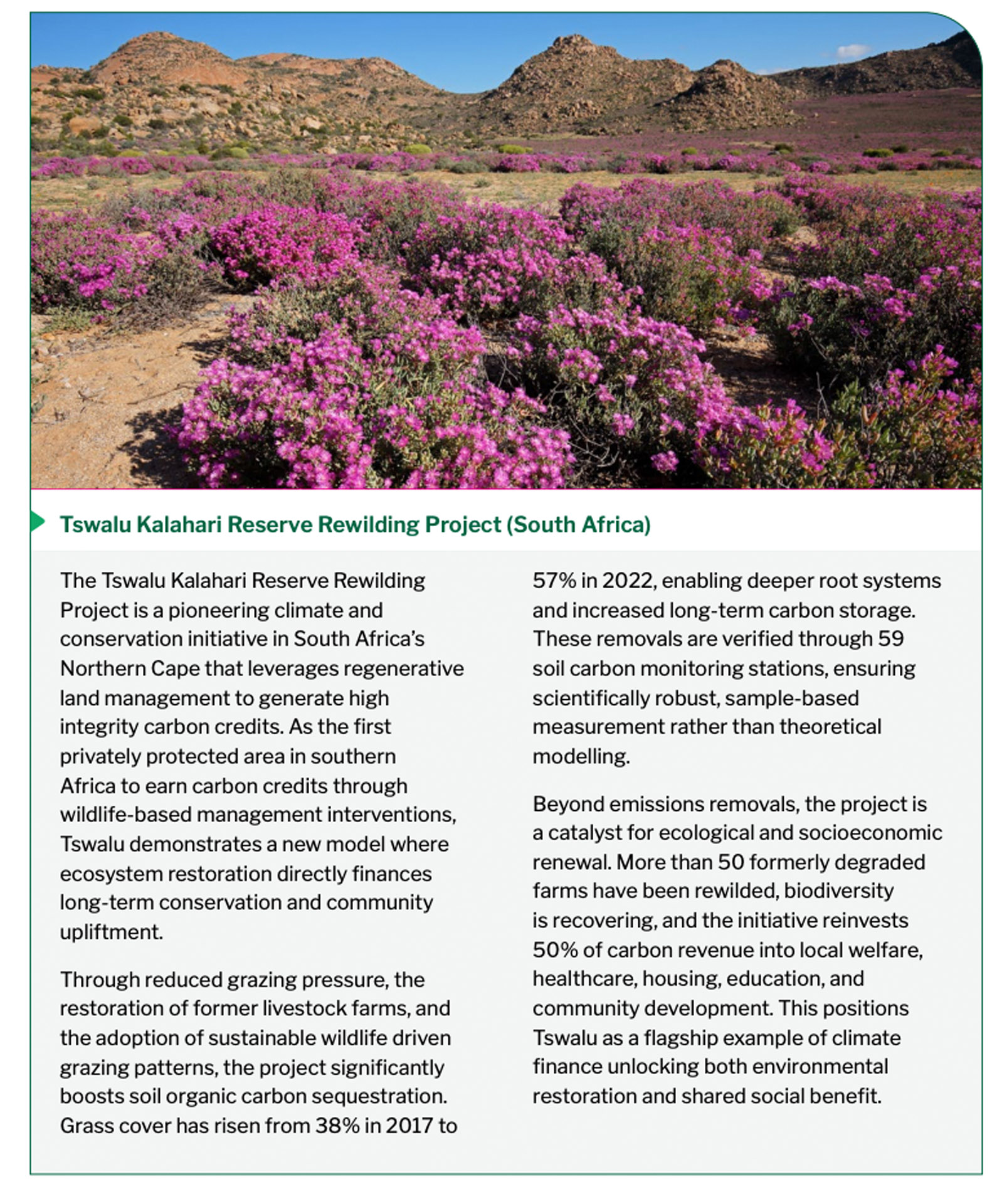
South Africa’s largest privately owned game reserve, Tswalu is an ambitious regeneration project conserving 118,000 hectares of the southern Kalahari, carbon neutral since 2019 and a certified Global Ecosphere Retreat®.
Tswalu became the first privately protected area in southern Africa to earn carbon credits through wildlife management. Wild animals graze, the soil stores more carbon, and the credits fund conservation. More than 34,000 credits have been issued so far, verified by Credible Carbon.
What’s interesting is who the story reached. It didn’t just grab the attention of people already passionate about conservation. It featured in Nedbank’s report and is now capturing the attention of finance people, an audience conservation storytelling almost never reaches.
The lesson: if you tell an impact story in the language of commerce, new audiences listen (and new funders arrive).
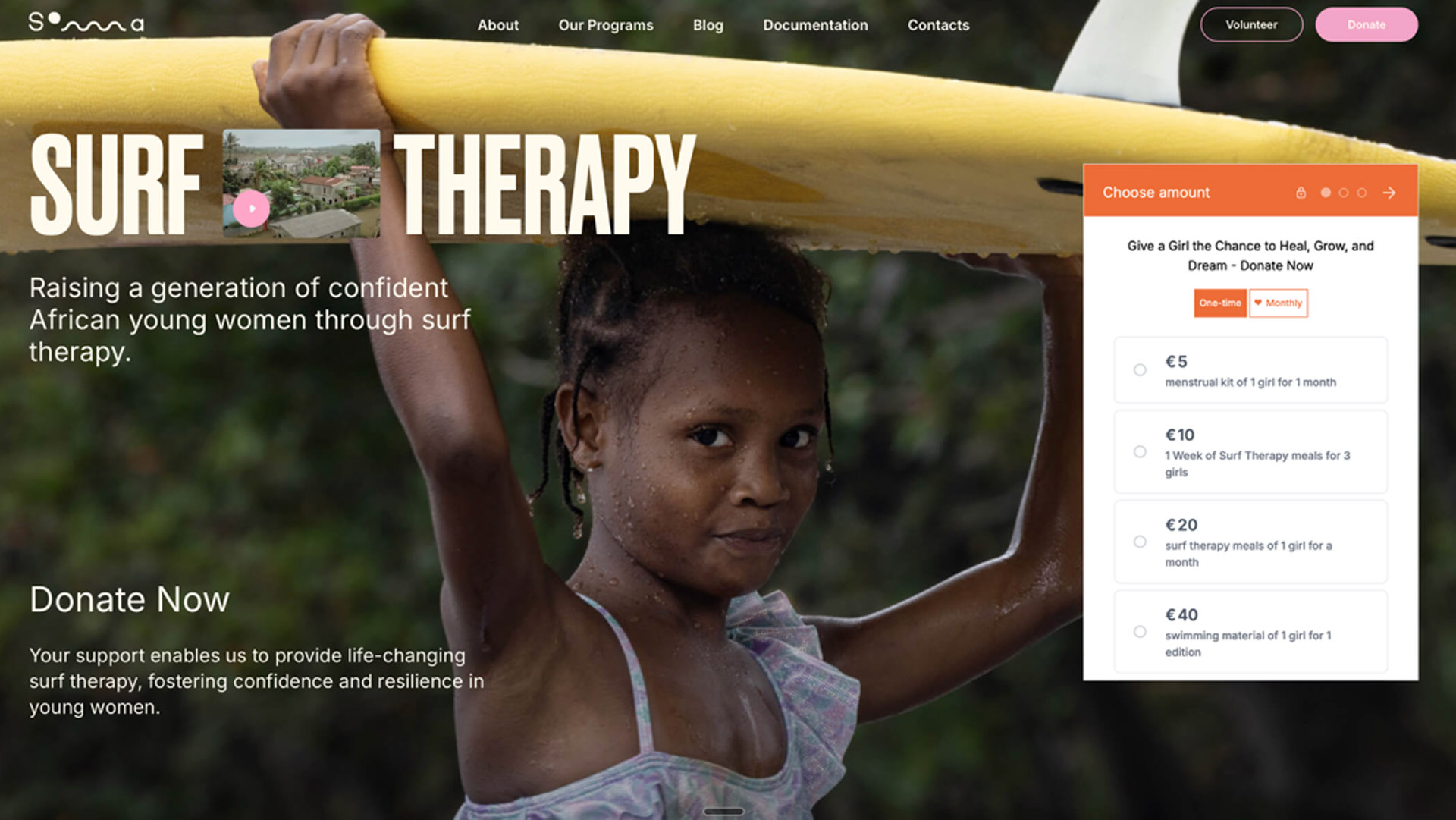
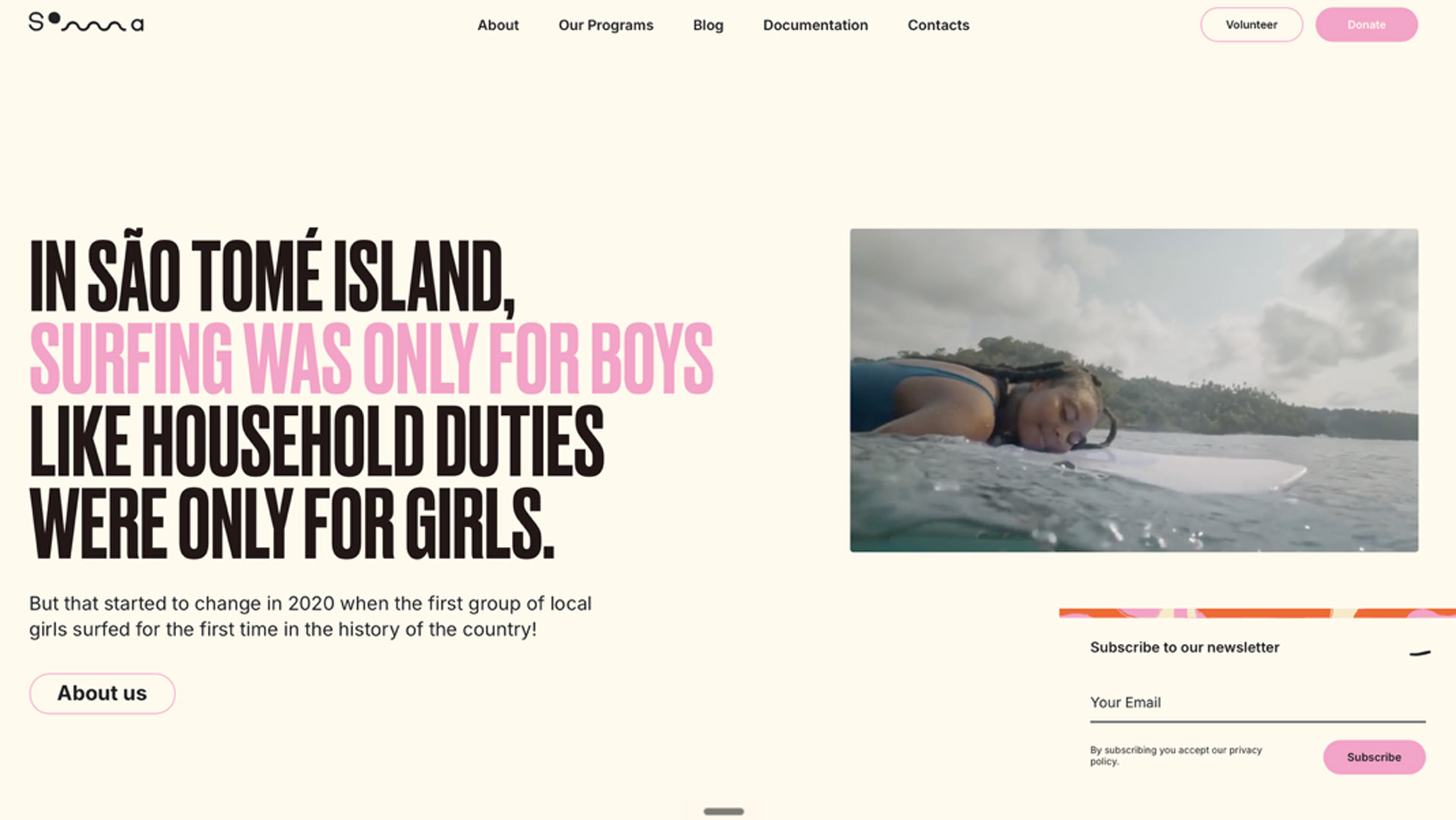
A sustainable ecotourism and agroforestry company on São Tomé and Príncipe, a UNESCO Biosphere Reserve, where more than 500 employees work towards conservation and community development on the rainforest island.
SOMA is a direct community project from the HBD Príncipe sustainability team. Their website is incredibly effective. What they do (surf therapy) and why it matters (you can change the lives of young African women) is crystal clear within the first 20 seconds of landing on the page. The bold, moody photography brings these words to life.
Once they’ve captured your attention and made you care about the cause, they back it up with facts and stats.
The lesson: the transparency does the closing: you donate because you know exactly where your money is going.
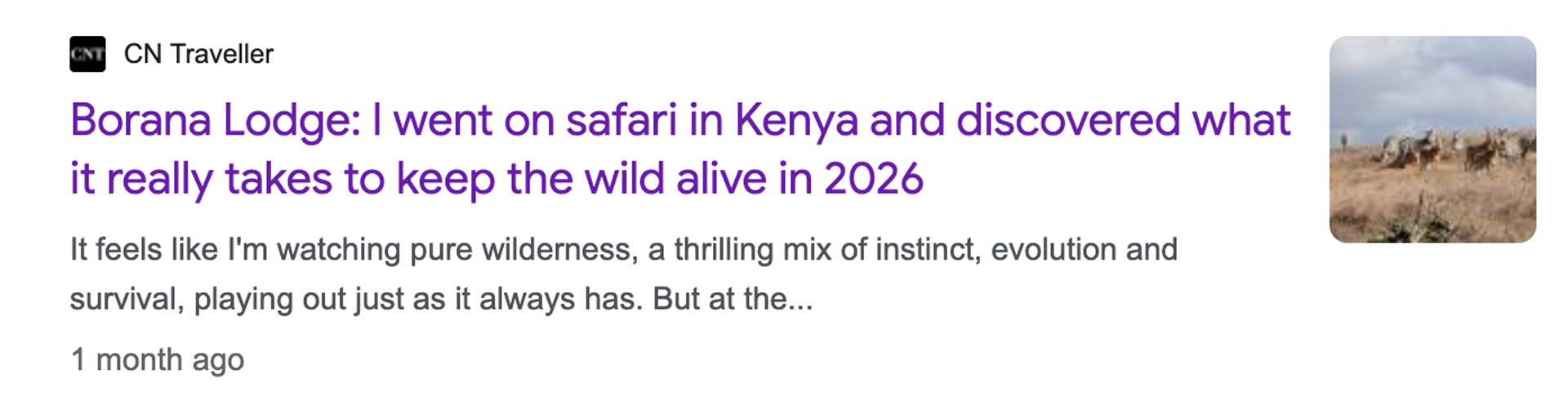
Set within Kenya’s Borana Conservancy, whose shared landscape with Lewa holds 13.5% of the country’s rhino population, Borana Lodge is one of the conservancy’s main economic drivers and a certified Global Ecosphere Retreat®.
Borana is where you will find Pride Rock, the real-life inspiration for the iconic scene in The Lion King. Most storytellers would lead with a fact like that. Borana’s leading story is something else entirely. Earlier this year they published a 10-year strategy to protect the future of African safari tourism. This is bolder than it sounds: lots of leaders splash bold statements across the media, Borana turned theirs into a strategy, put it in a report, and published it, which means the world gets to hold them accountable to it in 2036.
They can do this because they know exactly why they exist. Tourism, for Borana, is simply a vehicle for creating environmental and social stability. That why sits at the core of every story they tell. They even own the uncomfortable bits: their history page tells the colonial story of the land itself, the part most lodges would airbrush out.
The media have followed their lead. When Vogue, National Geographic and Fortune have featured Borana, the story has always led with conservation, never with the holiday. That headline belongs to their non-executive chairman, Giles Davies, few lodges could say it and be believed, but Borana can. And none of it comes at the expense of the business. They are the only lodge in Kenya to invest 24% of each guest’s stay directly into conservation. Off just eight rooms, the lodge generates more than US$700,000 a year for the conservancy, with US$1.27 million contributing to conservation in 2024 alone. Being this different isn’t a sacrifice but rather a commercial structure that works.
The lesson: great storytelling starts long before writing. Know exactly why you exist, then tell your story whole, uncomfortable bits included. People can feel the difference between a story that is curated and one that is true.
Most businesses measure their sustainability impact. Far fewer measure whether their communication about that impact is actually landing.
You do not need a sophisticated analytics system to get a read on this. A few signals are worth paying attention to: are trade partners using your language when they talk about you to clients, or reaching for generic sustainability claims instead? Are guests asking more specific questions, the kind that suggest they arrived knowing something real about you, not just a brochure? Is your impact story generating any media coverage, referrals, or repeat bookings you can connect back to a specific piece of communication?
None of these are precise metrics. But they are real signals. If the answer to most of them is no, that is useful information, not necessarily that your story is wrong, but that it may not yet be reaching the right people in the right form.
Put together a one-page impact summary with what you have right now. Do not wait until it is perfect. Share it with one trade partner this month.
If you are ready to formalise your impact practice, to move from the habit described here into structured baseline reporting: that is exactly the work The Long Run does with its members. The 4C Framework, the baseline dataset behind Section 03, and the working tools this guide draws on are all part of how we support businesses on that journey.
This guide was built from conversations with operators across Africa who are doing extraordinary work, often with limited resources and genuine complexity. Without exception, they had something worth saying.
Doing good has never been the problem. But the work needs to be visible, specific, and honest. And here is the thing: your story is no longer separate from your commercial profile. For a growing number of buyers, it is your commercial profile.
African tourism is not a recipient of the global sustainability conversation. It is one of its most important sources. That work deserves to be talked about with the confidence it has earned.
The work was already there. This is just help with the telling. We look forward to hearing your story.
The 41 data points below were derived through a structured cross-referencing process. The starting point was The Long Run’s own Phase 1 data-capture template, covering the four pillars: Conservation, Commerce, Community, Culture — as well as Travalyst environmental metrics. From this, the data points most likely to yield meaningful, comparable impact data across a diverse membership were identified.
The resulting set was then validated against two external benchmarks. First, it was cross-referenced against GRI (Global Reporting Initiative) and SASB Hotels & Lodging standards to identify material gaps at a basic ESG disclosure level, four governance data points were added as a result (ethics/anti-corruption, grievance mechanisms, health & safety, living wage). Second, the framework was pressure-tested against three hospitality-specific schemes: the WTTC Hotel Sustainability Basics (12 criteria), the Hotel Carbon Measurement Initiative (HCMI v2.0), and the Hotel Water Measurement Initiative (HWMI v1.1). Two further additions followed: total floor area of guest rooms and conditioned space (unlocking HCMI carbon-calculation compatibility and energy/water intensity KPIs), and organic / food waste as a distinct waste stream.
This tool is aligned with, but does not claim full compliance with, any of these frameworks. It is calibrated to what is practically achievable for small and medium-sized nature-based tourism businesses, most of which have limited reporting infrastructure.
| # | Data point | Unit | Source | 4C pillar |
|---|---|---|---|---|
| 1 — Business identity & governance | ||||
| 1 | Country and region | Text | The Long Run | Commerce |
| 2 | Organisation type | Pick list | The Long Run | Commerce |
| 3 | Year business started operating | Year | The Long Run | Commerce |
| 4 | Reporting period (data timeframe) | Date range | The Long Run | Commerce |
| 5 | Has a strategic sustainability plan in place? | Yes / No / NA | The Long Run | Commerce |
| 6 | Holds a certification? (name + expiry) | Yes/No + text + date | Travalyst · The Long Run | Commerce |
| 7 | Does the business have an ethics or anti-corruption policy? [ESG] | Yes / No | GRI 205 | Commerce |
| 8 | Is there a mechanism for employees or stakeholders to raise concerns or grievances? [ESG] | Yes / No | GRI 2-26 | Commerce |
| 9 | Does the business have a health and safety policy covering employees? [ESG] | Yes / No | GRI 403 | Community |
| 10 | Does the business pay employees at or above the local living wage? [ESG] | Yes / No | GRI 202-1 | Community |
| 2 — Commercial viability | ||||
| 11 | Is the business profitable? | Yes / No / NA | The Long Run | Commerce |
| 12 | Total revenue from tourism | USD | The Long Run | Commerce |
| 13 | Total guests / visitors in reporting period | Number | The Long Run | Commerce |
| 14 | Total bednights occupied | Number | Travalyst | Commerce |
| 15 | Total investment in 4Cs activities (absolute) | Currency | The Long Run | Commerce |
| 16 | Investment in 4Cs as % of revenue | % | The Long Run | Commerce |
| 3 — Supply chain & procurement | ||||
| 17 | Total spent on suppliers | USD | The Long Run | Commerce |
| 18 | Local supplier spend as % of total | % | The Long Run | Commerce |
| 4 — Employment | ||||
| 19 | Total employees (FTE) | Number | The Long Run | Community |
| 20 | Employees from local community | Number | The Long Run | Community |
| 21 | Employees from wider country (non-local) | Number | The Long Run | Community |
| 22 | International employees | Number | The Long Run | Community |
| 5 — Community reach | ||||
| 23 | Number of communities the business interacts with | Number | The Long Run | Community |
| 24 | Number of community members reached by projects | Number | The Long Run | Community |
| 25 | Number of community / NGO partnerships | Number | The Long Run | Community |
| 6 — Land & conservation | ||||
| 26 | Terrestrial area owned or managed | Acres | The Long Run | Conservation |
| 27 | Terrestrial area influenced but not owned | Acres | The Long Run | Conservation |
| 28 | Number of threatened or endangered species protected | Number | The Long Run | Conservation |
| 7 — Environmental management | ||||
| 29 | Total floor area of guest rooms and conditioned space [HSB] | m² | Architectural / property records | Conservation |
| 30 | Electricity consumption | kWh | Travalyst · HSB M1 | Conservation |
| 31 | Primary fuel consumption (dominant stationary fuel) | Litres / Kgs | Travalyst | Conservation |
| 32 | Water consumption (municipal / supply) | KiloLitres | Travalyst · HWMI · HSB M2 | Conservation |
| 33 | Waste to landfill | Kgs | Travalyst · HSB M4 | Conservation |
| 34 | Waste recycled | Kgs | Travalyst · HSB M4 | Conservation |
| 35 | Organic / food waste [HSB] | Kgs | HSB M4 · GRI 306 | Conservation |
| 36 | Renewable energy generated (solar primary) | kWh | Travalyst · HCMI · HSB M1 | Conservation |
| 8 — Carbon | ||||
| 37 | Does the business calculate carbon emissions? | Pick list | The Long Run · HSB M3 | Conservation |
| 9 — Culture | ||||
| 38 | Number of cultures / ethnic groups in operating area | Number | The Long Run | Culture |
| 39 | Cultural heritage or spiritual sites present? | Yes / No / NA | The Long Run | Culture |
| 40 | Number of local cultures protected or celebrated | Number | The Long Run | Culture |
| 41 | Does the business support local artists or artisans? | Yes / No / NA | The Long Run · HSB People | Culture |